How to Decarb Cannabis for Edibles (Decarboxylation Guide)
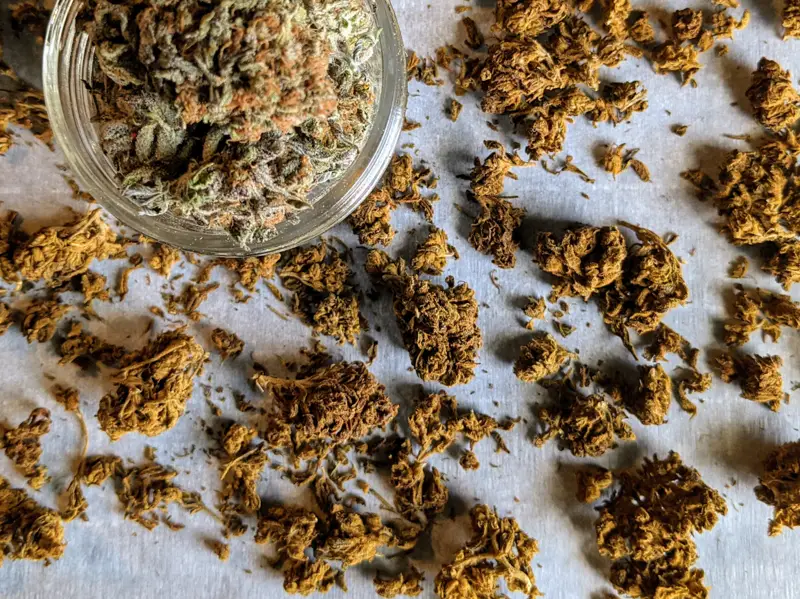
Table of Contents
Decarboxylation — "decarbing" — is the single most important step in making cannabis edibles. Skip it or do it wrong and your edibles won't work. This guide covers the science, every method, time and temperature charts, troubleshooting, and gear recommendations.
If you've ever eaten raw cannabis and felt nothing, now you know why. Raw flower contains THCA, not THC — a non-intoxicating acid form that your body can't process the same way. Decarboxylation is the chemical process that converts THCA into active THC (and CBDA into CBD) by applying heat over time.
Before you make cannabutter, cannabis oil, tincture, or any infusion — you decarb first. Every time. Without exception.
This guide covers the full process: the science, all four methods ranked by results, exact time and temperature guidance, and what to do when things go wrong.
New to edibles? Read our Cannabis Edibles 101 guide first for the full picture before diving into decarbing.
What is decarboxylation?
Decarboxylation is a chemical reaction that removes a carboxyl group (COOH) from a molecule, releasing carbon dioxide (CO₂) in the process. In cannabis, this reaction converts:
- THCA → THC (the primary intoxicating cannabinoid)
- CBDA → CBD (the primary non-intoxicating cannabinoid)
Raw, unheated cannabis contains mostly THCA and CBDA. These acid forms have their own properties but don't produce the psychoactive effects most edible-makers are looking for. Heat — applied at the right temperature for the right amount of time — drives the reaction and activates your cannabinoids.
When you smoke or vape cannabis, the flame or heating element decarbs it instantly. For edibles, you apply controlled heat deliberately before cooking.
Does decarbing happen during infusion?
Partially — but not reliably enough to skip a dedicated decarb step. Infusion temperatures (160–185°F) are lower than optimal decarb temperatures (220–250°F), so you won't achieve full conversion during infusion alone. Always decarb first for maximum potency and consistency.
The right temperature and time
Temperature and time work together. Higher temperature = faster decarb but more risk of burning off cannabinoids and terpenes. Lower temperature = slower but gentler, preserving more flavor.
| Method | Temperature | Time | Notes |
|---|---|---|---|
| Oven (standard) | 240°F (115°C) | 40 minutes | Best balance of speed and preservation |
| Oven (low and slow) | 220°F (105°C) | 60 minutes | Better terpene retention, more forgiving |
| Sous vide | 203°F (95°C) | 90 minutes | Most precise, best smell containment |
| Ardent FX / Nova | Automated | ~60–90 min | Set-and-forget, lab-verified efficiency |
| Crockpot (during infusion) | 160–185°F | 4–8 hours | Partial decarb only — not recommended as primary method |
The most important variable: your oven's actual temperature. Home ovens are notoriously inaccurate — running 25–50°F hotter or cooler than the dial says. An oven thermometer is non-negotiable for this step. Mine runs 50°F hot, which means I'd be burning my cannabinoids at what I thought was 240°F.
What you'll need
| Tool | Why it matters | What I use |
|---|---|---|
| Oven thermometer | Confirms your oven's actual temp | My oven thermometer |
| Kitchen scale | Weigh cannabis accurately | My kitchen scale |
| Baking sheet | For oven method | Any rimmed sheet pan |
| Aluminum foil | Covers and seals the cannabis | Standard kitchen foil |
| Mason jar with lid | For jar method (better smell containment) | wide-mouth mason jars |
| Grinder | For even, consistent grind | My grinder |
Want to skip the oven entirely? A decarboxylation device like the Ardent FX or LEVO 2 automates the process with lab-verified results and almost zero smell. See our infusion machine buying guide for a full comparison.
Method 1: Oven on a baking sheet (most common)
The standard method. Simple, effective, no special equipment beyond an oven thermometer. The tradeoff: your house will smell like cannabis for an hour.
Time: 40–60 minutes active + cooling Smell level: High
Steps
- Preheat your oven to 240°F (115°C). Use your oven thermometer to verify the actual temperature — adjust your dial until the thermometer reads correctly.
- Grind your cannabis coarsely. You want roughly the texture of dried herbs — not powder, not whole buds. Even grinding = even decarb.
- Spread on a foil-lined baking sheet in a thin, even layer. Don't pile it — you want heat to reach all the material evenly.
- Cover loosely with foil. This traps some heat and moisture, and helps reduce smell slightly.
- Bake for 40 minutes, checking occasionally. The cannabis will shift from green to a light golden-brown. That color change is a good sign — it means decarbing is happening.
- Remove and cool completely before using. Hot cannabis going directly into butter or oil can cause temperature spikes that degrade your cannabinoids.
Signs it went well
- Color shifts from bright green to light brown or olive green
- The smell is earthy and toasted, not burnt
- No dark brown or black spots (those mean too hot)
Method 2: Oven in a mason jar (better smell containment)
Same oven decarb, but sealed in a mason jar. The jar traps a significant amount of smell and also keeps your cannabis contained — less mess, and you can go straight from the jar into your infusion without transferring.
Time: 60 minutes active + cooling Smell level: Moderate (much better than open baking sheet)
Steps
- Preheat oven to 240°F (115°C) — verify with your thermometer.
- Grind cannabis coarsely and add to a clean, dry mason jar. Seal the lid finger-tight.
- Place the sealed jar on a folded kitchen towel on a baking sheet (the towel buffers against cracking from rapid temperature change).
- Bake for 60 minutes. The jar takes longer to heat through than an open sheet pan, so the extra time compensates.
- Remove carefully — the jar will be very hot. Allow to cool completely with the lid on before opening.
- Your cannabis is ready to go straight into your infusion.
Method 3: Sous vide (best precision, best smell containment)
Sous vide — a water bath held at a precise temperature — is the most controlled decarb method available without a purpose-built device. Because the cannabis is vacuum-sealed, smell is almost completely contained. The lower temperature also preserves more terpenes, which affects flavor.
Time: 90 minutes active + cooling Smell level: Very low
What you'll need
- Sous vide immersion circulator (my pick)
- Vacuum sealer or heavy-duty zip-lock bag
- Large pot or container for the water bath
Steps
- Grind cannabis coarsely and vacuum-seal in a bag. If you don't have a vacuum sealer, use a zip-lock bag and submerge it slowly in water to push the air out before sealing.
- Set your sous vide to 203°F (95°C) and allow the water bath to reach temperature.
- Submerge the sealed bag — clip it to the side of the container so it stays fully submerged.
- Cook for 90 minutes.
- Remove, cool completely before opening. Use immediately in your infusion or store sealed.
Method 4: Decarboxylation machine (easiest, most consistent)
Purpose-built devices like the Ardent FX, Ardent Nova, and LEVO 2 were designed specifically to decarb cannabis precisely, repeatedly, and with minimal smell. The Ardent FX has published third-party lab testing showing 97%+ THCA-to-THC conversion — the highest verified efficiency of any method.
Time: 60–90 minutes (hands-off) Smell level: Very low to none
If you're using expensive concentrates, making infusions regularly, or smell containment is a priority, a decarb device pays for itself quickly in consistent, efficient results.
Compare decarb devices in our full buying guide →
Decarbing different cannabis materials
Flower
The standard. Grind coarsely, spread evenly, follow the oven method above. Target 240°F for 40 minutes.
Kief
Kief is concentrated trichomes — potent and easy to decarb. Spread in a thin layer on foil, cover, and bake at 240°F for 20–30 minutes. Kief is finer and more delicate than flower, so it decarbs faster. Watch it closely.
Concentrate (wax, shatter, oil)
Concentrates are already partially decarbed through extraction, but benefit from a quick finish. Spread on parchment paper on a baking sheet and bake at 200–220°F for 20–25 minutes. They'll melt and bubble slightly — that CO₂ releasing is the decarb reaction happening. Cool completely before using. Never microwave concentrates.
Trim and shake
Works exactly like flower — just lower potency, so you'll use more of it. Follow the same process: coarse grind, 240°F, 40 minutes.
How to store decarbed cannabis
Once decarbed, activated cannabis can be stored and used later — you don't have to infuse it immediately.
- Airtight container (mason jar with a tight lid) in a cool, dark place
- Up to 3–6 months at room temperature — cannabinoids degrade slowly with heat and light
- Refrigerator or freezer for longer storage — up to a year
Label your container with the date, material type, weight, and THC percentage — you'll need this for the Potency Calculator when you're ready to infuse.
What to do with decarbed cannabis
Once decarbed, you have options:
Infuse it into a fat or alcohol — this is the most common next step, making a versatile ingredient you can cook with. See:
- How to make cannabutter
- How to make cannabis coconut oil
- How to make cannabis olive oil
- How to make cannabis tincture
Use it directly — decarbed cannabis can be mixed into foods, packed into capsules, or consumed as-is. It'll work — it just won't distribute as evenly in recipes as an infusion will.
Troubleshooting
My edibles are weak — did I decarb wrong? Most likely causes: oven ran too cool (verify with a thermometer), cannabis wasn't spread evenly, or decarb time was too short. Try again with a verified oven temperature and the full 40-minute time. Also check that you're using enough cannabis — use our Potency Calculator to verify your math.
My cannabis turned dark brown or black. Your oven ran too hot or the decarb ran too long. Dark material means you've started burning off cannabinoids. Dial your oven down — use your thermometer — and reduce the time. It may still work, just at reduced potency.
Nothing looks different after decarbing. That's actually normal — the visual change (green to light brown) is subtle and easy to miss. A slight color shift and toasted, earthy smell are your cues. Trust the temperature and time if your oven is verified.
The smell was unbearable. Switch to the mason jar method, sous vide, or an Ardent/LEVO device. All three dramatically reduce odor compared to the open baking sheet method.
I accidentally decarbed at too high a temp — is it ruined? Possibly reduced potency, but often still usable. If it smells burnt and is very dark, significant cannabinoid loss occurred. If it's light-to-medium brown with a toasted (not acrid) smell, you're probably fine.
Frequently asked questions
What is decarboxylation?
Do you have to decarb cannabis before making edibles?
What temperature should I decarb cannabis at?
How do I know when decarbing is done?
Can I decarb in a microwave?
Can I skip decarbing if I'm making cannabutter?
Does decarbing smell?
Can I decarb already-vaped cannabis (AVB)?
How long does decarbed cannabis stay potent?
Can I decarb kief, concentrate, or trim?
What's next
You've got activated cannabis — now put it to work:
- Make cannabutter — the most versatile infusion for baking
- Make cannabis coconut oil — great for vegan baking and capsules
- Make cannabis olive oil — best for savory cooking
- Make a tincture — fastest-acting, easiest to dose
- Calculate your potency before you cook
Or jump straight to browsing recipes if you already have an infusion ready.
Note: Cannabis laws vary by location. This guide is intended for use where cannabis is legal. Always check your local laws.
Comments#
Loading comments…
Leave a comment